
This page contains affiliate links. If you make a purchase through one, we may earn a commission at no extra cost to you.
Turkey hunting puts a genuinely different demand on your camo setup than big-game hunting does, and it’s not really about the pattern itself — it’s about two specific gaps that big-game hunters can usually get away with ignoring, but turkey hunters can’t.
Why Turkeys Are a Different Problem Than Deer or Elk
Turkeys have excellent color vision and are tuned to spot motion and exposed skin at close range in a way that most big-game concealment setups don’t fully account for. Big-game hunting from a treestand or a distance often gives you more margin for a slightly imperfect setup; turkey hunting frequently happens at very close range, sitting still on the ground, calling a bird in to within feet — which means the two spots most hunters overlook become the two spots that actually get you busted.
Face and Hands: The Two Things That Actually Give You Away
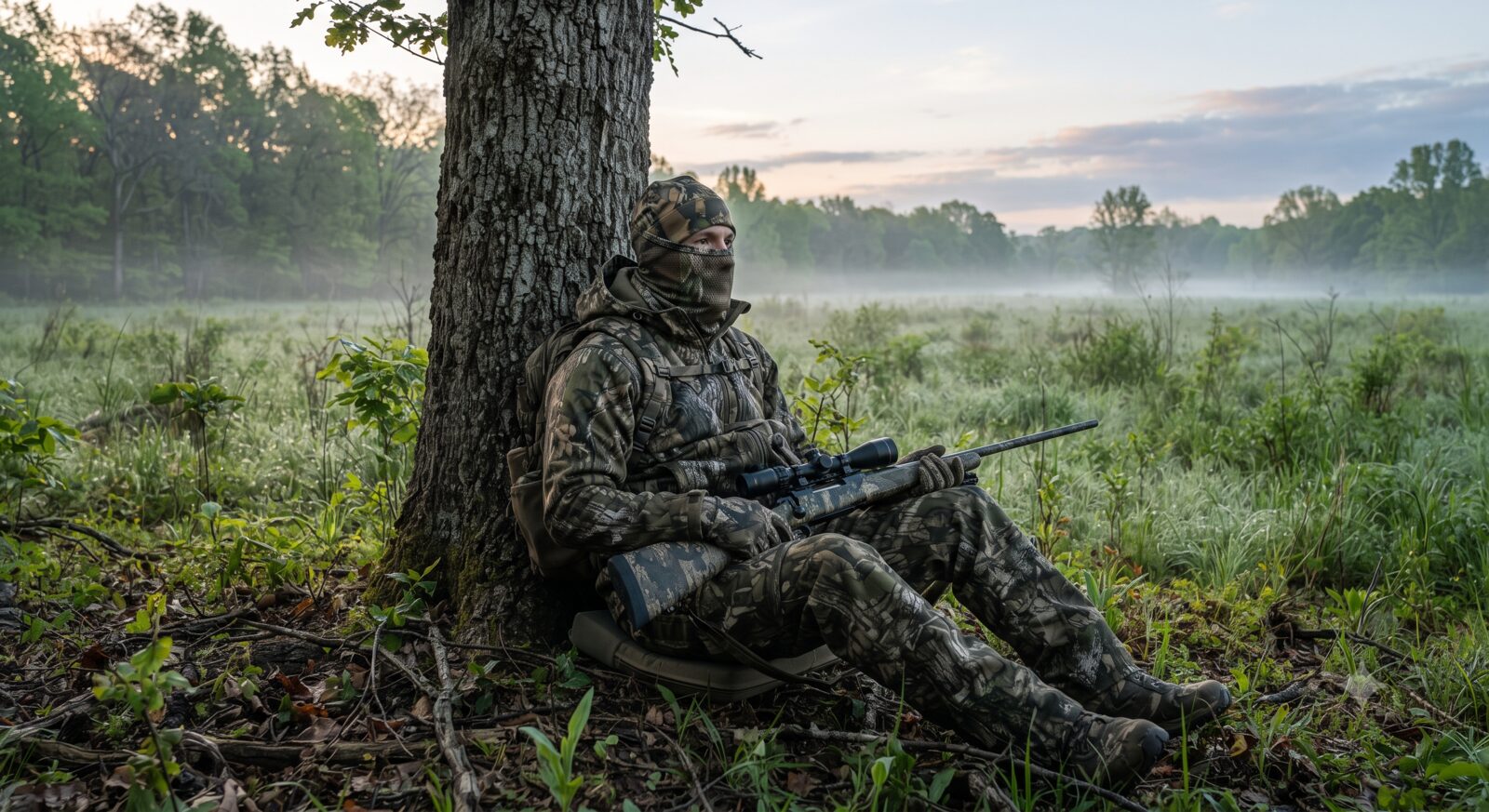
A pale, exposed face and bare hands moving to work a call are the two most common reasons turkey hunters get spotted, full stop — more than pattern mismatch, more than an imperfect setup elsewhere. A face mask or face paint and a pair of thin, camo gloves aren’t optional accessories for turkey hunting the way they might be for other species; they’re addressing the specific failure point that turkey vision is best at catching. If you skip a full camo suit for any reason, covering your face and hands is the one part not worth skipping.
Gloves Need to Balance Concealment and Dexterity
Thick winter gloves conceal your hands well but make it hard to work a call or handle a shotgun cleanly, which defeats the purpose if you can’t actually use your hands when the moment matters. Thin, lightweight camo gloves are the better fit for turkey hunting specifically — enough coverage to break up the outline of a bare hand without sacrificing the fine motor control calling and shooting both require.
Color Matters More Than Pattern Complexity Here
Because turkeys see color vividly, matching your camo’s actual color palette to your specific habitat carries more weight for turkey hunting than it does for species with weaker color vision — earth-tone greens and browns for wooded terrain, lighter tans for open fields, the same terrain logic covered in our camo pattern guide, but with less room for error given how close-range turkey hunting typically is. King’s Camo’s pattern lineup covers both ends of that terrain spectrum if you’re building a setup specifically with turkey season in mind.
Movement Discipline Still Beats Any Amount of Gear
Worth stating plainly: no amount of face and hand coverage substitutes for actual movement discipline. A fully camo’d-out hunter who moves too much or too fast at close range still gets picked off, since motion is what a turkey’s vision is most sensitive to overall, more than color or pattern specifically. Face masks and gloves close the “exposed skin” gap; staying still closes the “motion” gap, and you genuinely need both, not one instead of the other.
Is a face mask actually necessary for turkey hunting, or is that overkill?
It’s genuinely one of the two most important concealment items for turkey hunting specifically — a pale, exposed face is one of the most common reasons hunters get spotted at close range, since turkeys are quick to recognize an exposed human face as a threat.
Do I need thick gloves or thin gloves for turkey hunting?
Thin, lightweight camo gloves are the better choice — they conceal bare hands without sacrificing the dexterity you need to work a call or handle a shotgun cleanly, which thick winter gloves make difficult.
Does camo pattern matter more for turkey hunting than for deer hunting?
Color accuracy matters more, specifically, since turkeys have vivid color vision. Matching your camo’s actual color palette to your habitat carries more weight here than it does for species with weaker color vision.