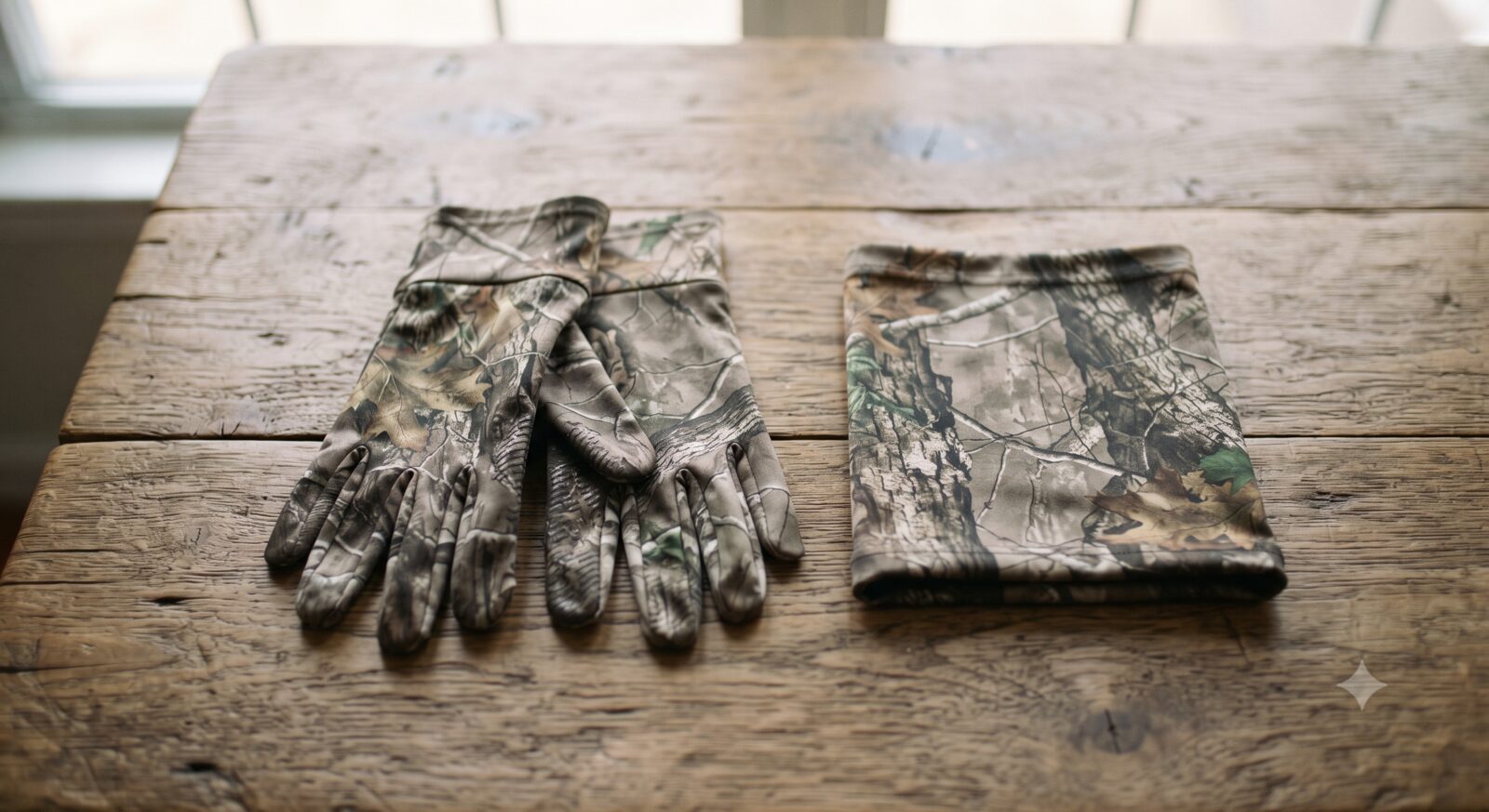
Most hunters spend real time and money dialing in a jacket and pants, then grab whatever gloves are in the truck and call it done. Hands and faces are two of the most visually exposed, highest-motion parts of your body in the field, and they deserve more thought than an afterthought purchase.
Why Hands and Faces Are a Bigger Deal Than They Seem
Your face and hands are the two parts of your body most likely to be visible above or outside your other gear, and they’re also the parts most likely to move — checking your phone, adjusting a rangefinder, working a call, wiping your face. Pale, exposed skin moving against a still, camo’d-out background is a strong visual signal precisely because it contrasts with everything around it, regardless of how good the rest of your setup is.
Choosing Gloves: The Real Tradeoff Is Warmth vs. Dexterity
There’s no single “best” hunting glove — the right choice depends on what you actually need to do with your hands. A stand hunter in deep cold, sitting mostly still, can prioritize maximum insulation since fine motor control matters less. A hunter who needs to handle a bow, work a call, or operate a rangefinder needs a thinner, more dexterous glove even if it means sacrificing some warmth, since gloves too thick to function in are gloves that come off at the moment you actually need your hands covered.
A practical solution many hunters land on is layering two glove weights: a thin liner glove for dexterity-critical moments, worn under or swapped for a thicker mitten-style outer glove during long stationary stretches. This gets you both warmth and function instead of compromising on one to get the other.
Face Coverage Options
- Mesh face masks cover skin while staying breathable enough to avoid fogging glasses or overheating during exertion — a real, common complaint with heavier face coverage.
- Neck gaiters pull up to cover the lower face and neck and push back down easily, which makes them more versatile than a fixed mask for hunters who need to eat, drink, or call without fully removing face coverage.
- Face paint is the lowest-cost, lowest-hassle option, and some hunters genuinely prefer it for comfort in warmer conditions where any fabric over the face feels excessive, though it needs reapplying if you sweat it off during a long sit.
Match Color to Your Pattern, Not Just “Any Camo”
A glove or mask in a mismatched camo color can stand out against your jacket the same way a mismatched jacket stands out against terrain — worth choosing accessories that actually complement the pattern and color palette you’re already wearing, using the same terrain-and-season logic covered in our camo pattern guide, rather than treating gloves and masks as an unrelated afterthought purchase.
Should I prioritize warm gloves or dexterous gloves?
It depends on what you’re doing — stationary stand hunting in cold weather favors maximum warmth, while activities requiring fine motor control (calling, handling a bow, using a rangefinder) favor thinner, more dexterous gloves even at some cost to warmth.
Is face paint as effective as a face mask?
Both work for covering exposed skin. Face paint is lower-cost and can feel more comfortable in warm conditions, but needs reapplying if sweat wears it off, while a mesh mask or gaiter stays in place through a longer sit.
Does it matter if my gloves and mask don’t match my jacket’s exact camo pattern?
A mismatched color or pattern on gloves and masks can create the same kind of visual contrast problem as a mismatched jacket against terrain, so it’s worth choosing accessories that complement your overall setup rather than picking any camo item at random.